
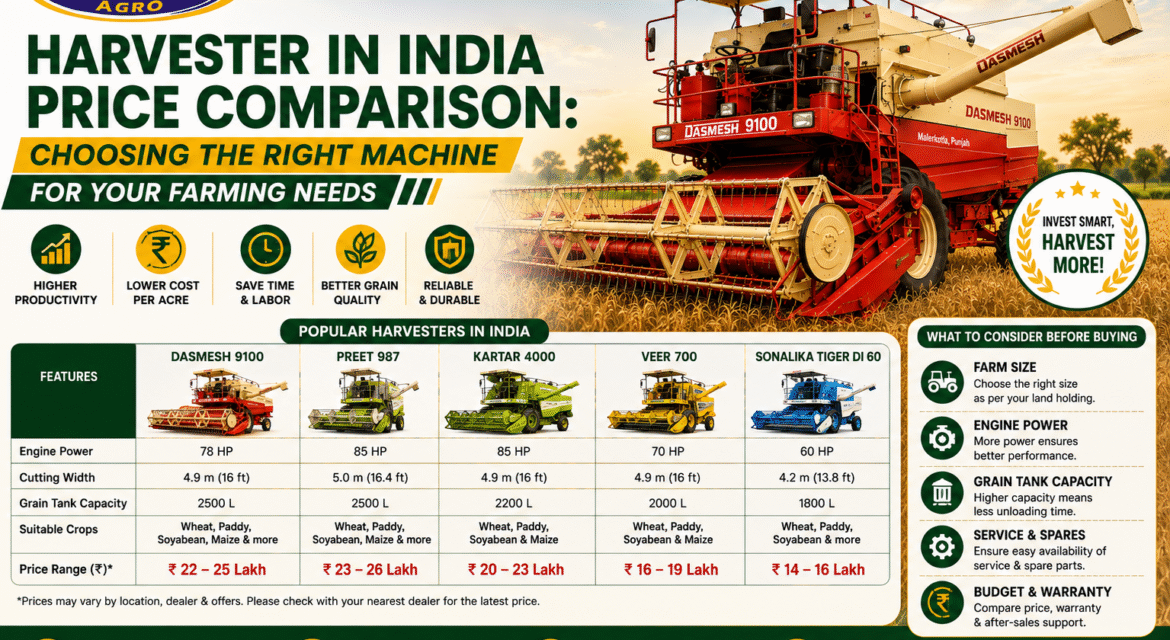
Modern farming in India requires reliable harvesting machinery that can perform the harvesting work quickly and reduce dependence on manual labour. The combine harvester is an important machine for farmers who grow wheat, paddy, maize, barley, soybeans, and other suitable crops, as it performs harvesting, threshing, and cleaning in a single operation.
The price of a harvester in India depends on the brand, model, engine power, cutting width, crop configuration, and type of machine. Combine harvester market listings as of 2026 indicate prices starting from around ₹16.50 lakh, with many popular self-propelled models ranging from ₹20 lakh to ₹35 lakh.
So farmers should not select a harvester just based on its price. The machine’s capacity, crop suitability, fuel consumption, maintenance costs, and after-sales service are equally important.
Also Read: Dasmesh Combine Harvester: Features, Benefits & Price Guide
Importance of Combine Harvester for Indian Farmers
Harvesting is one of the most time-pressing tasks in farming. Delays can increase crop losses and add to the labour costs.
Combine Harvesters combine:
- Collection
- Threshing
- Cleaning
This allows farmers to perform several operations in one pass.
The main advantages are:
- Faster harvesting of
- Reduced labour requirement
- Less time to harvest
- Improved field productivity
- Grain collection efficiency
- Less reliance on manual harvesting
Different Types of Harvesters Available in India
Depending on the crop and the farming requirements, there are different types of harvesting machines available for the farmers.
1. Self-Propelled Combine Harvester
A self-propelled combine harvester has its own engine and drive system.
It’s targeted at farmers and agricultural contractors who need a dedicated harvesting machine for larger areas.
Popular machines in this category are models such as
- Dasmesh 9100
- Preet 987
- Kartar 4000
- John Deere W70.
- New Holland TC5.30
Current listings show these machines vary considerably in price and specification, so farmers should compare the exact configuration before buying.
2. Tractor Attachments (Harvester on Tractor)
A combine harvester mounted on a tractor uses the power of the tractor.
This can reduce the initial outlay compared to buying a fully self-propelled machine.
This option may be worth considering if farmers already have the suitable tractor.
3. Follow Combine Harvester
The track uses crawler-type tracks instead of normal wheels.
They can be useful in wet or rugged field conditions where traction is important.
A paddy-cultivating farmer, while choosing between a wheeled or track machine, has to meticulously take into account the field conditions.
Harvester Price in India Compared
The following are examples of the price ranges on popular machines and configurations.
| Harvester | Power | Indicative Price |
| Dasmesh 912 | 55-75 HP | Around ₹8.40 lakh |
| Kartar 3500 | 74 HP | Around ₹18.70 lakh |
| Dasmesh 9100 | 101 HP | ₹23.50-₹34.50 lakh |
| Preet 987 | 101 HP | ₹23.50-₹27.15 lakh |
| Kartar 4000 | 101 HP | ₹21.50-₹26.25 lakh |
| John Deere W70 | 100 HP | ₹29-₹29.50 lakh |
| New Holland TC5.30 | 138 HP | ₹29.51-₹34.51 lakh |
These are indicative ex-showroom prices as per 2026 market listings as of now. Actual prices will vary by state, dealer, configuration, taxes, and available options.
1. Dasmesh 9100
Dasmesh 9100 is a 101 HP self-propelled combine harvester.
Published specifications include.
- 101 HP motor
- 6 cylinders
- 14″ cut width
- 5 straw walkers
- Fuel Tank – 370 Litres
- Grain tank 2.7 m³
- Weight: 9,125 kg approximate
Prices on the street are in the range of ₹23.50 lakh to ₹34.50 lakh depending upon the configuration.
Best For:
- Big farms
- Wheat harvest
- Paddy harvesting.
- Custom Harvesting Services
- Farmers want a high-capacity machine.
2. Preet 987
Preet 987 is yet another 101 HP Combine Harvester and belongs to the same general category as the Dasmesh 9100.
The price of the car ranges from ~₹23.50 lakh to ~₹27.15 lakh.
It can be used by farmers requiring a high-capacity harvesting machine for the appropriate crops.
3. Kartar 4000
Also, the Kartar 4000 comes with 101 HP power.
Its price range is currently listed between ₹21.50 lakh and ₹26.25 lakh.
Farmers and ag contractors looking for a higher-capacity 101 HP combine may want to look at this machine.
4. John Deere W70
The John Deere W70, with a power rating of 100 HP, is available now at a price point of approximately ₹29 lakh to ₹29.50 lakh.
Farmers who are considering this machine should consider its price against its service support, specs, crop suitability, and expected operating costs in their area.
5. New Holland TC5.30
The New Holland TC5.30 is a more powerful option with a listed power of 138 HP.
This is currently available at a price range of around ₹29.51 lakh to ₹34.51 lakh.
It may be a better choice for farmers or contractors who need more power and harvesting capacity.
How to Choose a Harvester?
The cheapest machine is not always the best one.
Farmers need to choose a harvester according to their real farming needs.
Size of farm
Think about how many acres you need to harvest each year.
It may not be economical to buy a high-capacity machine for a small area.
Better utilisation for large farms and custom harvesting operations can be achieved with higher capacity machines.
Type of Crop
Different crops may need different machine settings and configurations.
Make sure that the machine is right for you before purchasing:
- Wheat.
- Corn Paddy
- Barley.
- Soybean,
- Mustard
- Pulses
Check with the manufacturer or dealer for precise crop compatibility.
Field Conditions
“Field conditions are important, especially for paddy harvesting.
If your fields are wet at harvest time, you might want to think about whether a wheeled or track machine is better suited.
Cutting Width
Cutting width is how much of the crop can be harvested in one pass.
A wider cutter bar can offer better field coverage, but the machine should still be suitable for your field size and conditions.
Grain Tank Size
Larger grain tanks will also cut down on unloading stops.
This can be useful for large-area harvesting.
For example, the Dasmesh 9100 is advertised with a grain tank of 2.7 m³.
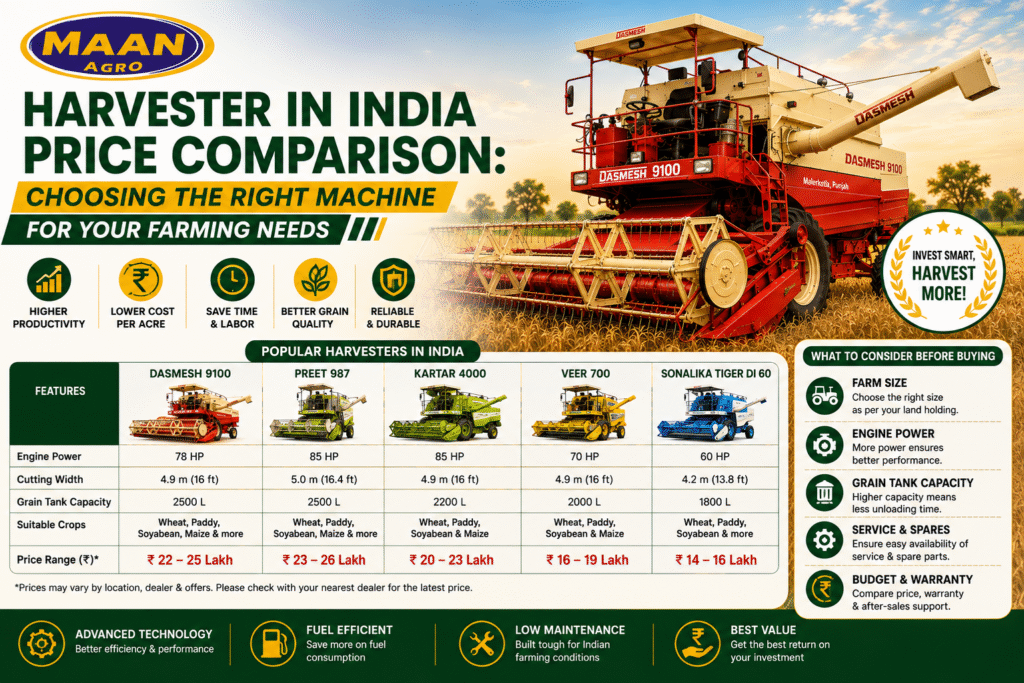
How Much Does a Harvester Cost in India?
The cost of a harvester in India varies a lot depending on the type of machine.
A smaller harvesting machine or tractor-mounted one costs a lot less than a big self-propelled combine.
Showing 2026 listings currently:
- Entry-level and smaller options can start at under ₹10 lakh.
- Mid-range combos could be priced at around ₹18-₹25 lakh.
- 101 HP machines are typically in the range of ₹21-₹35 lakh
- Higher power machines can cost over Rs 30 lakh.
The prices shown are indicative online prices and are subject to change. Always confirm the final price with the dealer before purchase.
Operating Cost vs Purchase Price
Farmers need to think beyond the purchase price of a harvester to the total cost of ownership.
Think:
- Cost of machine
- Fuel usage
- Maintenance
- replacement parts
- Cost to operator.
- Insurance Transport Storage
- Seasonal service
A machine with a low purchase price might have high operating expenses. Similarly, a more costly machine can be economical if it harvests more acres per day and provides dependable performance.
Buy a Harvester or Rent One?
Farmers can sometimes avoid the need to buy a combine harvester.
When to Purchase
- Have a large farm
- Thousands of acres harvested yearly.
- Provide customised harvesting services.
- Machine regularly needs
- Want to control harvest times completely.
You Are Better At Hiring When
- Have a little farm
- Use the harvester only once a year.
- I don’t want maintenance costs.
- Have used local custom hire services
The decision should be based on annual machine utilisation and cost per acre.
Important Features to Look for Before You Buy
Before buying a harvester, check.
- Engine power
- Width of cut
- Threshing cylinder
- Straw walkers
- Grain bin.
- Fuel tank
- Cleaning system
- Transmission
- Tyres or Tracks
- Comfort for the operator
- Fuel economy
- Need for maintenance
- Availability of spare parts
- Guarantee
- After-sales service
A field demonstration can also help farmers see the actual performance of the machine.
How to Compare Harvester Prices the Right Way
Don’t just compare the headline prices.
Compare the following:
| Factor | Why It Matters |
| Purchase Price | Determines initial investment |
| Engine Power | Affects machine capacity |
| Cutting Width | Determines field coverage |
| Grain Tank | Reduces unloading interruptions |
| Fuel Consumption | Controls operating cost |
| Crop Compatibility | Ensures suitable harvesting |
| Maintenance | Affects yearly expenses |
| Spare Parts | Reduces downtime |
| Service Support | Helps during harvesting season |
| Warranty | Provides purchase protection |
This provides a fuller picture of the machine’s worth.
Why Maan Agro for Agriculture Machinery?
It’s important to choose the right supplier when buying expensive agricultural equipment.
Maan Agro is engaged in providing farming machinery solutions to farmers who wish to enhance the efficiency of harvesting and reduce their dependency on labour.
The advantages for farmers are:
- Good agricultural machinery
- Professional advice
- Original spare parts
- Dependable after-sales service
- Technical assistance
- Customer Support
If you are thinking of harvester price options in India, Maan Agro can help you understand your farming needs and select suitable machinery as per your crops, farm size, and budget.
Also Read: Dasmesh 9100 Harvester Price, Specifications & Buying Guide
Conclusion
The right combine harvester helps farmers to save time and reduce labour requirements and helps to complete harvesting operations in an efficient manner. However, the best machine is not necessarily the one with the lowest price.
Farmers should compare the price of harvesters in India on the basis of engine power, cutting width, suitability of crops, capacity of grain tank, fuel efficiency, maintenance, availability of spare parts, service support and total cost of operation.
Models like Dasmesh 9100, Preet 987, Kartar 4000, John Deere W70 and New Holland TC5.30 are in different pricing and performance categories. Current 2026 listings show prices can vary widely depending on model and configuration.
Make comparisons on the basis of your own farming needs before you purchase. Ask the dealer for a detailed quotation.
Looking to buy a combine harvester or any other farm equipment? Contact Maan Agro for guidance and suitable farming solutions.
FAQs: Frequently Asked Questions
1. How much does a harvester cost in India?
Ans: Harvester pricing differs between types and models of machines. Currently, listings for 2026 show combine harvesters priced from around ₹16.50 lakh, with many popular self-propelled machines costing between ₹20 lakh and ₹35 lakh.
2. Which is the best combine harvester for Indian farmers?
Ans: The right machine depends on the farm size, type of crop, field conditions, budget, and harvesting requirements. Popular models are Dasmesh 9100, Preet 987, Kartar 4000, and other machines in different power and price ranges.
3. What is the cost of the Dasmesh 9100?
Ans: Currently, the market information published shows the Dasmesh 9100 priced at around ₹23.50 lakh to ₹34.50 lakh, depending on the configuration.
4. Can a combine harvester be used in paddy?
Ans: Yes. Most of the combine harvesters are meant for paddy harvesting. However, farmers should select the machine as per the field conditions and ascertain the crop suitability of the particular model.
5. Is it better to buy a harvester or hire one?
Ans: For farmers harvesting large acreage or offering custom harvesting services, buying may be a good option. If a small farmer only occasionally uses a machine, hiring may be cheaper.