
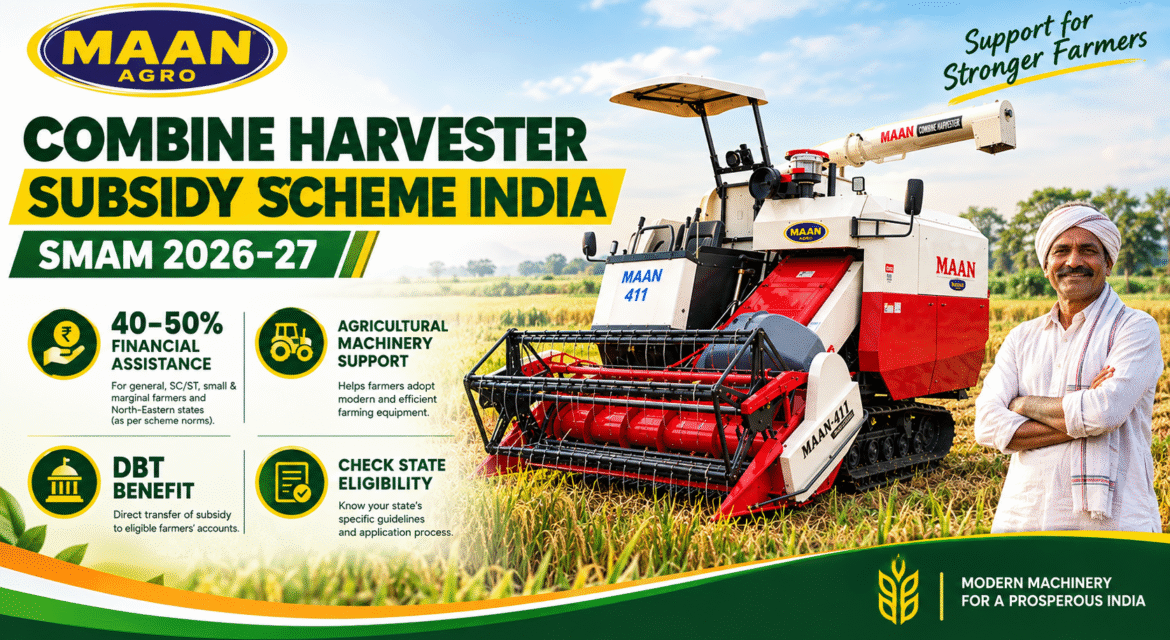
Modern agricultural machinery is becoming increasingly important for Indian farmers. The Combine Harvester is a machine that can do harvesting, threshing, separation, and cleaning in one machine, which helps farmers save time and reduce dependence on manual labour.
However, buying a combine harvester is a substantial investment. The Government of India provides financial support under agricultural mechanisation programs to encourage farm mechanisation and to make agricultural machinery affordable.
The Combine Harvester Subsidy Scheme in India is primarily linked to the Sub-Mission on Agricultural Mechanisation (SMAM) and its state-level implementation. The government portal on agricultural machinery provides information on machinery assistance, applications, beneficiary selection, dealers, and subsidy-related processes.
Farmers should be aware of the eligibility conditions, the subsidy limits that apply, the application process and the requirements of the state before buying a Combine Harvester.
Also Read: Maan-411 Combine Harvester
What is the Combine Harvester Subsidy Scheme in India?
The Government of India launched the National Agricultural Equipment and Machinery Scheme (NAEMS) in 2014 to encourage the use of agricultural machines in farming. This scheme provides subsidies to farmers and entrepreneurs for purchasing agricultural machinery, including tractors, seed drills, and combine harvesters.
The Government of India is promoting farm mechanisation through the Sub-Mission on Agricultural Mechanisation (SMAM). The goal is to make agricultural equipment more accessible, especially for farmers who may be priced out of modern equipment on their own. The scheme also provides for Custom Hiring Centers and mechanisation services to enhance access to machinery.
Financial assistance shall be provided to the eligible agricultural machinery as per approved cost norms and beneficiary categories under the agricultural mechanisation system.
The SMAM cost norms are applicable to the following categories of machinery, including combine harvesters.
What is the subsidy offered on a combine harvester?
The subsidy is not merely a set percentage of the machine’s market price.
The Government of India issued SMAM cost norms specifying the percentage of assistance and maximum permissible subsidy for different types of combine harvesters.
The published SMAM guidelines, for example, include the following assistance structure:
| Combine Harvester Category | Maximum Permissible Cost Norm for Eligible Categories | Assistant | Maximum Cost Norm for Other Beneficiaries | Assistant |
| Self-propelled Combine Harvester | ₹9.60 lakh | 50% | ₹7.68 lakh | 40% |
| Tractor-powered, without a tractor | ₹3.60 lakh | 50% | ₹2.88 lakh | 40% |
| Tractor-powered, with tractor | ₹8.70 lakh | 50% | ₹6.96 lakh | 40% |
| Track Type: below 6 ft cutter bar | ₹8.40 lakh | 50% | ₹6.72 lakh | 40% |
These numbers are based on the published SMAM cost norms and do not imply a guaranteed subsidy on each machine purchase. Final assistance may be subject to the applicable financial year, state implementation, beneficiary category, approved machinery, and available target.
Thus, farmers should consider the existing notification of the state and the official agriculture machinery portal before making a purchase.
Who may receive a grant for agricultural machinery?
The SMAM framework is to increase access to farm mechanisation, especially for farmers and areas with limited access to farm power and machinery. It also promotes the provision of custom hiring centres to address the high cost of individual ownership.
The assistance pattern can be different for categories of beneficiaries depending on the guidelines and the way they are implemented by the state.
The published cost norms provide for higher rates of assistance for categories such as:
- Small and marginal farmers
- Female farmers
- SC/ST Beneficiaries
- Beneficiaries in some regions, including eligible Northern Eastern States
- Other qualifying beneficiaries
- Please check with the relevant state agricultural department and also the current SMAM application system for exact eligibility.
Subsidy on Combine Harvester Importance
Combine harvesters can be costly compared to conventional harvesting tools.
Financial assistance is available to eligible farmers to help offset the initial investment.
The main benefits of mechanical harvesting are:
- Quick harvesting
- Lower demand for labour
- Harvesting delays are lower.
- Efficient threshing.
- Integrated grain cleaning
- Better use of machines
- Increased farm productivity
For farmers with a narrow window of time between the maturity of the crop and a shift in the weather, the timing of the harvest can be particularly important.
Benefits of Using a Combined Harvester
1. Faster Gathering
A combine harvester can harvest a large area in less time than manual harvesting.
This enables farmers to complete the harvesting operations in the period available for harvesting.
2. Less dependence on labour
Shortages of labour at peak harvesting times can raise costs and lead to delays.
Mechanisation reduces the amount of manual labour required for harvesting and threshing.
3. Multiple operations on a single machine
A combine harvester can combine.
- Harvesting
- Threshing
- Separation
- Cleaning
- Grain collection
That is why you do not need all of these separately.
4. Improved Harvesting Efficiency
Modern harvesting machines can help farmers deal with larger fields efficiently and avoid relying on conventional harvesting methods.
5. Good For Custom Hiring
Farmers who purchase eligible machinery can use it in custom harvesting operations as long as they adhere to the applicable rules and requirements.
The agricultural mechanisation framework also promotes Custom Hiring Centers to enhance farmers’ access to expensive machinery.
How to Apply for a Subsidy on a Combine Harvester in India?
The subsidy application process for agricultural machinery may vary from state to state, as the subsidy implementation is through state-level targets and procedures.
The Government of India’s agricultural mechanisation portal is an online system for farmers and other stakeholders.
The general process can contain the following steps.
Step 1: Verify Qualification
First, farmers need to determine if they qualify to participate in the applicable state SMAM programme.
To qualify, you may have to:
- Farmer classed
- country
- Region
- Farming or landholding requirements
- Type of equipment
- Past subsidy benefits
- Aims of the existing scheme
Step 2: Register yourself at the Agricultural Mechanisation Portal
Farmers qualified for the program might need to register through the appropriate government agricultural mechanisation system or state portal.
The different access levels in the official system are farmers, dealers, manufacturers, entrepreneurs, societies, SHGs and FPOs.
Step 3: Choose the Required Machinery
After registration, the farmer can utilise the eligible agricultural machinery available under the current state target.
The availability of the combine harvester is subject to the state’s approved annual action plan and machinery targets.
Step 4: Submit the Necessary Documents
The exact list of documents varies by state.
Farmers may need to provide documents including:
- Proof of identity / Aadhaar
- Bank account information
- Farmer registration data
- Land/cultivation-related documents
- Certificate of category if applicable
- Documents of residence or domicile
- Other documents as required by the state department of agriculture.
Farmers should apply only after checking the state notification for current status.
Step 5: Selection of Beneficiary
Applications for subsidies can be processed according to the approved state procedure.
In certain cases, beneficiaries are chosen through an online lottery system. Such a process is now presented on the official agricultural mechanisation portal in some state applications.
Step 6: Buy From a Legitimate Dealer
The farmers will have to buy the approved agricultural machinery through the relevant government process from an eligible or registered dealer.
The official portal also has a Know Your Dealer facility and maintains information related to the registered manufacturers and dealers.
7. Subsidy Verification and Release
Post-purchase, the machine may need to be physically verified as per the applicable process.
According to the official portal, under certain circumstances, applications for individual machinery can be forwarded for physical verification.
Eligible subsidy assistance is processed as per the rules of the applicable scheme after verification and documentation as required.
Combine Harvester Subsidy Required Documents
Documents required vary from state to state, but farmers should generally have the following information ready.
- Aadhaar card
- Bank account details
- Farm Registration
- Land records
- Passport-size photographs
- Phone number
- Category certificate, if any
- Proof of residency (if required)
- Quotation or Machine Details
Other documents requested by the State Department of Agriculture
Please check the latest document requirements before submitting the application.
Is any combine harvester eligible for a subsidy?
Nope.
Farmers should not take for granted that all the available combine harvesters in the market are eligible for subsidy.
The machinery shall conform to the requirements of the applicable scheme, approved specifications, cost norms, and conditions at the state level.
The government portal also mentions that manufacturers and dealers have to submit product prices for each financial year, which are then approved by the respective state or district authorities.
Hence, before paying an advance, farmers need to verify whether the particular model they want to buy is eligible.
Subsidy on Combine Harvester to Small & Marginal Farmers
Small and marginal farmers face a problem with the purchase of expensive agricultural machinery.
Such farmers are targeted by agricultural mechanisation programs to increase their access to machinery.
The cost norms published under SMAM have a higher assistance pattern for certain categories of beneficiaries than for others. The published norms for the listed categories of combine harvester show 50% assistance for specific categories and 40% for other beneficiaries, within the maximum permissible subsidy limits.
The actual benefit available to an individual farmer should be confirmed under the present state programme.
Women Farmers’ Combine Harvester Subsidy
The published SMAM framework proposes higher assistance patterns for the following beneficiary categories: women farmers.
The eligibility and availability are subject to the current financial year, state target, machinery category, and applicable rules.
For women farmers, contact the state agriculture department before buying machinery.
SC & ST Farmers Combine Harvester Subsidy
SC and ST farmers too may be eligible for a higher assistance category under relevant guidelines for agricultural mechanisation.
The exact subsidy depends on the type of machinery, approved cost norm, beneficiary status, and state implementation.
Farmers, while applying, should keep their valid category certificate and other necessary documents ready.
What Is a Custom Hiring Center?
Every farmer shouldn’t buy a combine harvester.
At times, hiring agricultural machinery can prove more practical for farmers with smaller landholdings.
Specifically, the SMAM framework promotes the establishment of Custom Hiring Centers (CHCs) to improve access to machinery and to overcome the high cost of individual ownership.
Custom hiring centres can provide machines to farmers on a rental basis.
This can help farmers to access:
- Combines with
- Tractors
- Rotary tillers
- Super Seeder
- Straw Harvesters
- Other agricultural machines
This model can be particularly useful where the annual use of a machine is too low to justify individual ownership.
Things to Look For When Buying a Combine Harvester
Even if you are eligible for a subsidy, you must choose the machine carefully.
Think about:
- Size of farm
- Crop type
- Annual area harvested
- Power of the engine
- Width of cut
- Tank capacity for grain
- Fuel usage
- Field Status
- Cost of operation
- Availability of spare parts
- Support from the dealer
- Guarantee
- Service after sales
Don’t choose a machine just because it is subsidy eligible.
Also, the machine should be appropriate for your actual farming needs.
Important Note On Combine Harvester Subsidy
Farmers should remember that the subsidy is not always 40% or 50% of the actual market price of the machine.
The scheme is predicated on approved cost norms and maximum allowable limits of subsidy.
For instance, the published guideline refers to a cost norm of ₹9.60 lakh with 50% assistance for a self-propelled combine harvester for the said beneficiary category. It is not that a farmer automatically gets 50% of the full retail price if the machine is substantially more expensive than the approved cost norm.
This distinction is important when calculating the actual amount that the farmer will have to finance.
Why Maan Agro for Agricultural Machinery?
Maan Agro is a provider of agricultural machinery solutions for Indian farmers, offering combine harvesters and other agricultural equipment.
Farmers planning to purchase a combine harvester should discuss:
- Machine model
- Crop needs
- Size of farm
- Ability to harvest
- Price
- Who can get a subsidy?
- Dealer process
- Sections
- After-sales service
Farmers should confirm the eligibility of the model and dealer selected with the applicable government subsidy process prior to purchase.
Also Read: Multicrop Combine Harvester – Engine Type: Air Cooled
Final Thoughts
Combine Harvester Subsidy Scheme India: It can reduce the price of modern harvesting machinery for eligible farmers. Under the Sub-Mission on Agricultural Mechanisation and its implementation at the state level, the Government provides financial assistance on the basis of the approved machinery categories, cost norms, beneficiary groups, and available targets.
The SMAM guidelines published cover combine harvesters, which are self-propelled, tractor-driven, and some track-type, within the cost norms for assistance.
However, the subsidy rules and the dates for application acceptance may vary from one financial year to another and also from one state to another. So, before purchasing any machinery, the farmers should look at the latest government portal and notification from the state agriculture department.
If you are looking to buy a combine harvester, Maan Agro can help you understand the options for agricultural machinery available and select the equipment as per your farming needs.
FAQs
1. What is the India Combine Harvester Subsidy Scheme?
Ans: Subsidy on combine harvesters is given under the agricultural mechanisation programs like Sub-Mission on Agricultural Mechanisation (SMAM). Financial assistance to eligible farmers for approved agricultural machinery is provided as per applicable cost norms and beneficiary categories.
2. What is the subsidy amount on a combine harvester?
Ans: The published SMAM cost norms provide assistance of up to 50% for specified beneficiary categories and 40% for other beneficiaries for listed Combine Harvester categories, subject to maximum permissible subsidy limits. The real advantage depends on the current state and financial-year rules.
3. What is the subsidy for combine harvesters for small and marginal farmers?
Ans: For instance, the published SMAM framework incorporates beneficiary categories such as small and marginal farmers under the higher assistance pattern. However, eligibility and availability depend on the current state programme, target allocation, and applicable conditions.
4. How to apply for the Combine Harvester subsidy?
Ans: Farmers need to register through the concerned government agricultural mechanisation or state portal, select the machinery they are eligible for, upload the required documents, and follow the process of beneficiary selection, purchase, verification, and subsidy release. Every state has its own specific process.
5. Not all Combine Harvesters are subsidised by the government.
Ans: Nope. The specific machinery should be as per the scheme requirements and should be included in the approved machinery and cost norms for the concerned state and financial year. Farmers should check for eligibility before purchasing the machine.