
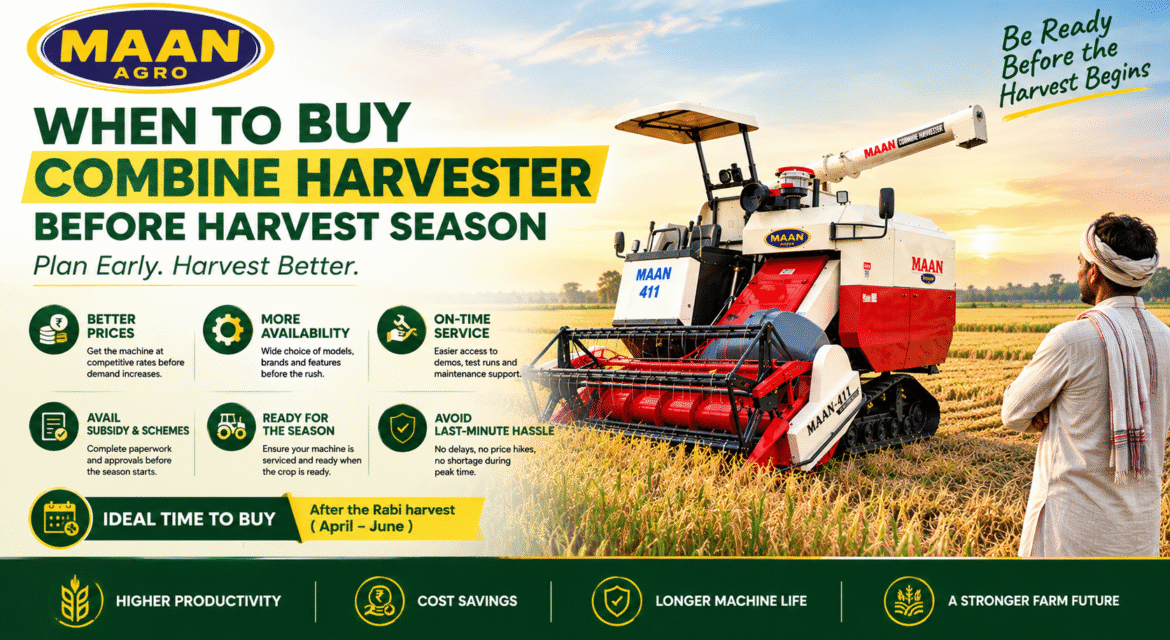
Harvesting is one of the most time-critical jobs in farming. When a crop is ready to harvest, farmers need reliable equipment to get the job done quickly and efficiently. Waiting until the harvesting season starts to purchase a combine harvester can make it more difficult to manage the pressure of machine demand, delivery schedules, servicing requirements, and dealer availability.
Knowing the right time to buy a combine harvester before the harvest season can help farmers plan their investment, get the machine properly prepared, and avoid last-minute problems.
A combine harvester is a big investment in farming. Farmers should consider the crop calendar, farm size, harvesting requirements, machine availability, budget, financing, servicing, and spare parts before purchasing.
Also Read: benefits of track harvester
Why Should You Buy a Combine Harvester Before Harvest Season?
The primary reason to purchase a combine harvester early is preparation.
You don’t always get to put off the harvest. When the crop is ready, farmers need machinery that is immediately available and in good working order.
Purchasing before the season gives farmers time to:
- Compare models
- Get the machine specifications.
- Arrange finance.
- Full documentation
- Check the machine
- Full Service
- Train operator
- Order spare parts
- Plan harvest activities
Preparation in advance helps the harvest season to be more organised and reduces unexpected delays.
When to buy a combine harvester?
Different crops and different regions have different harvesting seasons, so one perfect month for every farmer does not exist.
As a general planning approach, farmers should begin researching and comparing machines several months before the anticipated harvest time.
A possible timeline could be:
| Time Before Harvest | What Farmers Should Do |
| 4–6 months before | Research machines and estimate budget. |
| 3–4 months before | Compare models, prices and dealers. |
| 2–3 months before | Finalise machine and financing |
| 1–2 months before | Purchase, delivery and inspection |
| 2–4 weeks before | Service, testing and operator preparation |
| The time of harvest season | Machine ready for field operations |
The time frame may be adjusted based on the crop, location, availability of the machine, and dealer delivery schedule.
1. Start Researching 4-6 Months Before Harvest
Farmers should not wait until the crop is ready to begin the buying process.
You have 4 to 6 months before harvest to do the research that allows enough time to:
- Engine power
- Cutting widths
- Threshing system.
- Grain tank size
- Fuel use
- Crop suitability
- Capacity of machine
- Maintenance needs
- Replacement parts
- Dealer support
This allows farmers to draw up a shortlist of several machines, rather than make a rushed decision.
2. Compare Prices on Early Combine Harvester
“The cost of purchase is a big part of the decision but shouldn’t be the only factor.
Farmers should look at:
- Price of machine
- Fuel use
- Maintenance costs
- Operating expenses
- Replacement parts
- Limited Warranty
- Transport service assistance
- Expected lifetime of operation
Comparing these costs early will help farmers see the total investment better.
A lower purchase price machine does not guarantee the lowest operating cost.
3. Check for machine availability.
A high demand for combine harvesters is possible during the harvesting season and before.
“Farmers who leave it to the last minute will not get their first-choice model straight away.
Buying early gives you more time to:
- Choose the desired model.
- Confirm inventory
- Terms of Delivery
- Finish registering
- Configure the required equipment.
- Get the machine ready.
This can be especially important for farmers who need the machine at a specific time in the harvesting season.
4. Plan your financing in advance.
A combine harvester is a major investment, so it is important to plan your financing prior to the harvesting season.
Farmers should do the following calculations:
- Security Deposit
- Loan required
- Monthly payments
- Insurance interest expense
- Expenses, operating
- Maintenance cost
- Anticipated annual usage
- Plan for your finances to avoid last-minute pressure.
Farmers should also verify whether there is any government agricultural machinery subsidy or financing scheme available in their state before finalising the purchase.
5. Explore Government Subsidy Programs
Some farmers may qualify for financial help under agricultural mechanisation programs.
However, the availability of subsidy, eligibility, approved machinery, beneficiary categories, application windows, and state-level procedures may vary.
Before buying a machine, farmers have to check the suitable government scheme.
“Not all Combine Harvesters are automatically eligible for subsidy.
Please verify the specific machine and purchase process with the relevant government authority before making a final payment.
6. Buy before the demand peaks.
One of the biggest benefits of buying early is avoiding peak season demand.
Harvesting machinery may be required by farmers, agricultural contractors and custom hiring operators during the harvesting season.
This may lead to a demand for:
- Combining Data
- Sections
- Technical Staff
- Service appointment
- Operators of Transport
Farmers have more time to prepare everything with less pressure if they buy before the peak time.
7. Let the Machine Be Inspected
Farmers must check the combine harvester after purchasing it and before taking it to the field.
Key areas include:
- Motor
- Cutting system
- Thresher system
- Cleaning System.
- Grain bin
Hydraulic system:
- Belts/
- Bearings
- Tracks or tyres
- Electrical system
- Control
A pre-season inspection can identify issues before harvesting starts.
8. Check the combine harvester before harvest.
A field test or demonstration can provide useful data on machine performance.
Farmers are advised to note:
- Engine power
- Cutting performance
Capacity for threshing:
- Cleaning of Grain
- Grain losses
- Fuel use
- Motion of the machine
- Discharge operations
- Vibration & noise
If the machine is purchased a few weeks before harvest, there is time to correct any problem found in the test.
9. Operator Training
The operator has an important role in combine harvester performance.
Even the most sophisticated machine will produce poor results if not operated properly.
The operator should know before beginning the harvest:
- Controls (machine)
- Crop settings
- Cut length
- Threshing adjustments
- Settings of cleaning
- Discharging grain
- Safety procedures
- Daily inspections
- Easy troubleshooting
Training operators before the season will help to avoid mistakes and to increase harvest efficiency.
10. Have Spare Parts Ready Before Harvesting
Some components are subject to natural wear during harvesting.
“Farmers need to determine which parts are most often used and how readily available they are.
These might include:
- Belt
- Bearings, Blades, Filters, Chains
- Sprockets
- Threshing parts
- Lubricants
If you have the parts you need, you’ll spend less time down during harvest season if anything goes wrong.
11. Complete Pre-season Service
A combine harvester should be serviced before going into the field.
Important maintenance activities can be:
- Check engine oil level.
- Change Filter
- Belt examination
- Lubrication: Grease
- Inspection of the hydraulic system
- Check battery
- Tyre or track checking
- Cutting system verification
- Inspection of threshing system
- Inspection of cleaning system
- Inspection of electrical system
To ensure proper operation, the manufacturer’s service recommendations should be followed.
12. What’s Your Crop Calendar?
The right time to buy is very much dependent on the crop you are growing.
For instance, if wheat is being grown by the farmer, he has to plan his machinery requirements as per the probable wheat harvesting time.
Similarly, paddy, maize, soybean, mustard, and other crops have different harvesting windows.
Farmers should prepare a crop calendar showing:
- Anticipated Crop Maturity
- Projected harvest date
- Required harvest area
- Availability of machines
- Number of days for harvest
- Weather outlook
This simplifies the decision of when to buy and prepare the combine harvester.
Buying vs Hiring a Combine Harvester
If you are not a farmer, you do not have to buy a combine harvester.
Farmers should weigh the benefits and costs of ownership versus custom hiring.
| Factor | Buying | Hiring |
| Initial Investment | High | Low |
| Machine Availability | Under the owner’s control | Depends on availability |
| Maintenance | Owner’s responsibility | Usually included in service |
| Annual Use | Suitable for regular use | Suitable for occasional use |
| Custom Work | Can provide services | Cannot earn from machine ownership |
| Flexibility | Higher | Depends on the contractor |
If you do harvest large areas every year or provide custom harvesting services, it may make sense to buy.
Employment may be cheaper for smaller farms.
How to Reduce Harvesting Delays by Early Buying
Harvesting delays may be caused by.
- Shortage of machines
- Labour scarcity.
- Rain and wind
- Mechanical failure
- Delays in transport
- Service disruptions
- Lack of spare parts
It allows farmers more control over when they harvest, so they can purchase a combine harvester before the season.
Before the crop is ready, the machine can be inspected and serviced.
Things To Consider Before Buying
Things to consider before you buy a combine harvester.
Size of Farm
Choose the size of the machine depending on the total area you want to cut.
Crop Class
Make sure the machine is right for your crops.
Field Conditions
Different configurations of the machines may be required for wet, dry, soft, uneven, and firm fields.
Price Range
Look at both the purchase price and the long-term operating costs.
Gas Mileage
Fuel can be a significant operating expense.
Upkeep
Verify service prerequisites and maintenance costs.
Spare Parts
Ensure that genuine spare parts are available.
Dealer Support
Select a supplier that will provide you with reliable technical and post-sale support.
Warranty
Know what the warranty covers on the machine.
Why Maan Agro? Combine Harvester
Maan Agro provides solutions to Indian farmers in the form of agricultural machinery like combine harvesters and other farm equipment.
When buying a combine harvester, farmers should discuss their:
- Size of farm
- Type of crop
- Field conditions
Need for annual harvesting.
Budget:
- Capacity required of machine
- Service needs
Maan Agro can help farmers understand the options in agricultural machinery available and help them select the equipment as per their farming needs.
Before buying, farmers should check the latest specifications of the machine, its price, availability, warranty, and after-sales support.
Basic Timeline for Buying a Combine Harvester
A simple plan of action can ease the buying process.
6 months before harvest
Research different machines and see what your budget is.
4-Month Harvest
Specs, dealers, models, and financing options can be compared.
3 months before harvesting
Shortlist the machine and check availability.
2 Months Before the Harvest
Buy and schedule a delivery.
1 Month Before Harvest
Test and service the machine.
2 Weeks Until Harvest
Test and train the operators.
Harvest Time
Begin harvesting with a well-prepared machine.
Also Read: combine harvester subsidy scheme india
Final Thoughts
An advance purchase of a combine harvester before the commencement of harvest season can make a big difference in farm planning. Rather than wait until the crop readiness period, farmers should start looking into machines and comparing them months in advance.
Farmers should be starting the buying process about three to six months before they expect the harvest to allow time for machine selection, financing, delivery, inspection, servicing, operator training, and spare parts planning.
Best time may differ depending on crop, region, Super Seeder, machine availability and individual farming requirements. The objective is simple: To have a fully inspected and serviced Combine ready before the crop is ready to harvest.
Farmers who are ready to invest in agricultural machinery can look to Maan Agro for the right combine harvester as per the size of the farm, type of crop, and harvesting needs.
FAQs
1. When to buy a combine harvester, before harvest season?
Ans: Ideally, farmers should be starting research three to six months prior to the expected harvest. Acquire one to two months before harvest for adequate lead time for delivery, inspection, servicing, and operator training.
2. Why buy a combine harvester early?
Ans: When farmers buy early, they have more time to compare machines, arrange financing, confirm availability, complete servicing, arrange spare parts, and train the operator before harvest begins.
3. Should you buy or rent a combine harvester?
Ans: Farmers with large areas or regular harvesting needs may find it advantageous to buy. Hiring a combine harvester can be more economical if you have a small farm or use it occasionally.
4. What should I check during the pre-harvest season?
Ans: Engine, cutting system, threshing system, cleaning system, belts, bearings, hydraulic system, tyres or tracks, electrical components, fuel system, and safety controls.
5. Can I get a subsidy to buy a combine harvester?
Ans: Farmers who are eligible under the applicable agricultural mechanisation schemes can get financial assistance. However, the eligibility and subsidy amount will depend on the current government guidelines, state, machinery category, and beneficiary status. Farmers are urged to check the latest rules before buying.