
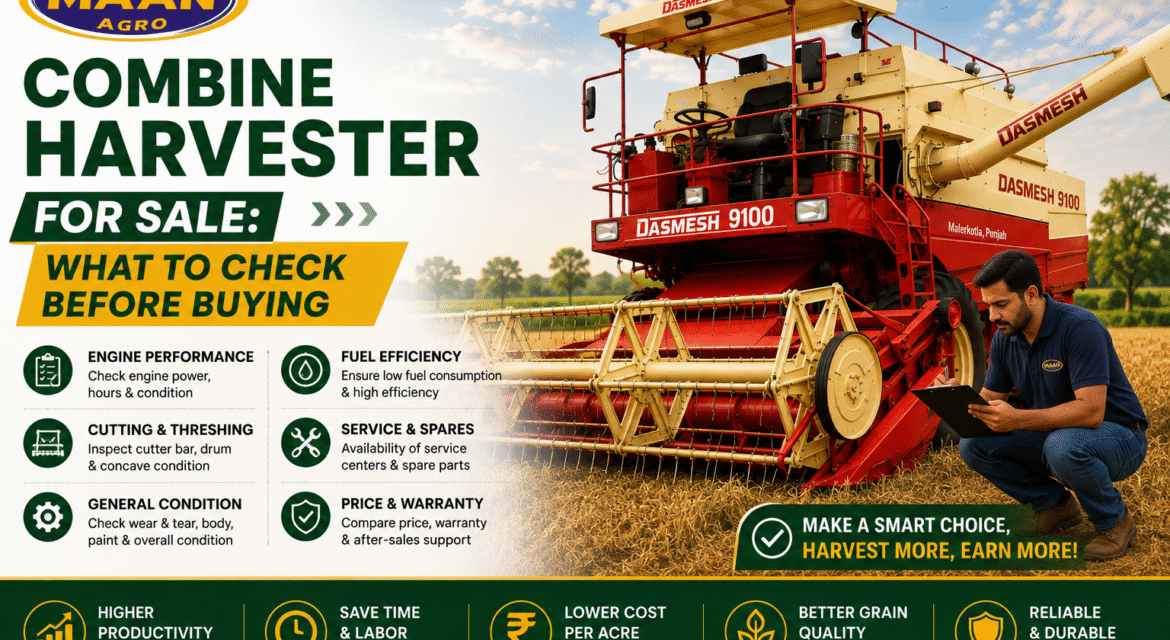
The purchase of a combine harvester represents a major investment for a farmer. The right machine can assist in finishing harvesting faster, reduce labour requirements, and improve overall farm productivity. However, farmers should not choose a machine only based on the combine price.
Before buying a new or a used combine harvester, you need to check its engine, harvesting capacity, crop compatibility, fuel consumption, maintenance, and after-sales service. A solid inspection can help lead a farmer to a machine that will do better and be more valuable over the long haul.
Also Read: Farm Machinery vs Traditional Farming Tools: Which is More Efficient?
Why Opt for a Combine Harvester?
Several harvesting operations can be done by one combine harvester.
The main operations are:
- Harvesting,
- Threshing
- Cleaning
This saves time and obviates the necessity of separate harvesting and threshing operations.
The main benefits of a combine harvester are:
- Harvesting faster
- Reduced labour requirement
- Less time to harvest
- Increased field productivity
- Thrashing efficiently
- Enhanced grain collection
It is more useful for those farmers who grow large fields of wheat, paddy, barley, soybean, mustard and other crops which can be harvested by this machine.
1. Engine Check
The engine is one of the most important parts to check before buying a combine harvester.
Long working hours, coupled with demanding field conditions, demand a powerful and reliable engine.
Check:
- Engine power.
- Starting engine
- Noise or vibration (unusual)
- Fumes from Exhaust
- Dripping oil
- Cooling system
- Fuel usage
If you are buying a used machine, ask how many hours it has and what kind of maintenance it has had.
2. Inspect the Cutting System
The cutting mechanism directly affects the harvesting performance.
What to check before you buy:
- Working width
- Blades
- Cutterbar
- Reel Belt Bearings
- Height adjustment mechanism
Replacing damaged or worn parts can increase your maintenance cost.
A wider cutting width can help you cover more area, but the machine should also suit your field size and conditions.
3. Examine the Threshing System
Threshing is the separation of grain from the harvested crop.
Look at the:
- Thresher cylinder.
- Concave
- Adjusting Drum Speed
- Belts
- Shafts
- Thresher parts
The system should run smoothly, without excessive vibration or unusual noise.
Correct machine settings are also important, as crop conditions can impact threshing performance and grain losses.
4. Inspect the Cleaning System
After threshing, the grain must be separated from straw and other unwanted material.
Verify the status of:
- Fan cleaning
- Sievs
- Grain storage facility
- Grain spout
- Cleaning system;
An efficient cleaning system helps to produce cleaner grain and reduce unnecessary losses.
5. Try out the Straw Walker.
Straw walkers are a key component of many conventional combine harvesters.
They are used to separate the remaining grain from the straw after threshing.
Check before buying:
- Walker’s condition
- Bearings Shafts
- Elements of drive
- Any cracking or overwear.
This inspection is especially important when buying a used combine harvester, as replacement of major components can be costly.
6. Confirm the Combine Price
The price of the combine can range widely depending on the model of machine, power of engine, configuration, type of crop, brand, location, and whether the combine is new or used.
Never compare machines on initial price only.
Think of:
- Buying price
- Fuel efficiency
- Cost of maintenance
- Cost of spare parts
- Insurance Transport Service costs
- Expected working lifetime
A somewhat more expensive machine to buy may be worth the price in the long run if it is more efficient and cheaper to run.
7. Used or New Combine Harvester
Farmers can opt for a new or used combine harvester depending on their budget and requirements.
| Factor | New Combine Harvester | Used Combine Harvester |
| Initial Cost | Higher | Lower |
| Machine Condition | New | Depends on usage |
| Maintenance | Usually lower initially | Maybe higher |
| Warranty | Generally available | Depends on seller |
| Spare Parts | Generally available | Should be checked |
| Technology | Latest features | Depends on model year |
| Risk | Lower | Requires detailed inspection |
“Used machines can be cost-effective as long as they are properly inspected and maintained.
8. Crop suitability check
Not every combine harvester is right for every crop and field condition.
Make sure the machine is suitable for your crops before buying.
Common crops harvested using combine harvesters include:
- Wheat
- Paddy
- Barley
- Soybean
- Mustard
- Pulses
- Maize
Some crops may require specific attachments or configurations for the crop.
9. Verify Gas Mileage
Fuel is a major operating cost in harvesting.
Fuel-hungry combine harvesters can make each acre harvested more expensive.
Ask about it before you buy:
- Estimated fuel consumption
- Efficiency of the engine
- Operating capacity per day
- Fuel tank capacity
- Field performance in practice
Fuel consumption varies with crop yield, moisture, field conditions, machine settings, and operator practices.
10. Check on machine capacity.
Select the machine based on the area you need to harvest.
A big farm may need a machine with a higher capacity, while a small farm may not need the same harvesting capacity.
Consider the following:
- Size of farm
- Acres harvested / day
- Yields from crops
- The time of harvest
- Number of crops
- Custom harvesting needs
“Choosing the right capacity avoids unnecessary investment.
Combine Harvester Buying Checklist
| What to Check | Why It Matters |
| Engine | Determines power and performance |
| Cutting System | Affects harvesting efficiency |
| Threshing System | Separates grain effectively |
| Cleaning System | Improves grain quality |
| Straw Walkers | Helps recover remaining grain |
| Fuel Consumption | Controls operating costs |
| Machine Capacity | Matches farm workload |
| Crop Compatibility | Ensures suitable operation |
| Spare Parts | Reduces downtime |
| After-Sales Service | Supports long-term operation |
| Warranty | Provides additional purchase protection |
| Combine Price | Helps manage overall investment |
Calculate the Real Cost of a Combine Harvester
“Farmers need to look beyond the purchase price when evaluating a machine.
The total cost may comprise:
- Purchase of machine
- Transportation Gas Maintenance
- Spare parts.
- Insurance
- Cost to operator
- Storage
- Seasonal Maintenance
A useful number to compare different machines is the total operating cost per acre.
Even if the combine price up front is higher, it can be economical if it covers more acres per day and has lower operating costs.
Combine Harvester for Small Farmers. What About It?
A combine harvester is not always economical for small farms to buy.
Farmers need to ask themselves:
- Total area of cultivation
- Annual harvesting need
- Machinery
- Costs of maintenance
- Custom hiring services are offered.
If the machine will only be used for a small number of acres each year, it may be a more practical option to hire a combine harvester.
Are Combine Harvesters Worth It for Large Farms?
The combine harvester can provide major benefits to large farms.
It can assist farmers:
- Quickly harvest larger areas.
- Reduce dependence on labour.
- Timely harvest completion
- Shorten harvest delays
- Enhance operational efficiency
Some owners use combine harvesters to provide custom harvesting services, which can offer additional use and income potential.
Why Should You Purchase Agricultural Machinery From Maan Agro?
Selecting the right supplier of agricultural machinery is important for long-term performance.
Maan Agro offers agricultural machinery solutions for farmers who want to increase harvesting efficiency and reduce dependency on manual labour.
The benefits for farmers are:
- Good agricultural machinery
- Professional advice
- Original spare parts
- Dependable after-sales service
- Technical assistance
- Customer Service
If you want to buy a combine harvester, Maan Agro can help you to assess your needs and choose the right agricultural machinery for your farm size, crops, and budget.
Also Read: Essential Farm Tools and Equipment Every Indian Farmer Should Own
Final thoughts
It is a huge decision for farmers to buy a combine harvester, and they should check the machine properly before they decide to buy it. The combine price is important, but it shouldn’t be the only factor.
Check the engine, cutting system, threshing mechanism, cleaning system, fuel consumption, machine capacity, crop compatibility, maintenance requirements, spare parts, warranty, and after-sales service.
For used machines, it is especially important to conduct a detailed inspection and field test.
The right combine harvester can help farmers save time, reduce labour costs, improve harvesting efficiency, and get field operations done on time. If you are planning to buy agricultural machinery, then contact Maan Agro and get the perfect solution for your farming needs.
FAQs: Frequently Asked Questions
1. What to check before buying a combine harvester?
Ans: Check the engine, cutting system, threshing system, cleaning mechanism, fuel consumption, crop compatibility, machine capacity, spare parts, warranty, maintenance, and after-sales service.
2. Factors affecting the combine price?
Ans: The price of the combine depends on the model, engine power, machine capacity, crop configuration, brand, location, features, and whether it is a new or used machine.
3. Should I buy a second-hand combine harvester?
Ans: A second-hand combine harvester can be a viable option if it has been well inspected and has a good maintenance history. Before purchase, check the engine, harvesting components, gearbox, tyres and other major systems.
4. What crops can be harvested by a combine harvester?
Ans: Depending on the machine and configuration, Combine Harvesters can be used for crops such as wheat, paddy, barley, soybean, mustard, pulses, and maize.
5. Why is fuel efficiency important in a combine harvester?
Ans: Fuel is a primary operating cost. Better fuel efficiency helps to reduce the cost of harvesting each acre.