Change in modern agriculture is coming fast. Farmers are looking for better ways to do farming operations in less time, with lower labour costs and better productivity. For generations, farmers have used traditional tools, but modern farm machinery has made many agricultural operations faster and more efficient.
Some farming activities still use tools such as ploughs, sickles, hand hoes and traditional seeders. But machines like combine harvesters, rotavators, super seeders and tractors can do large farming operations in much shorter time.
So which is the more efficient option? The answer depends on the size of the farm, the type of crop, the labour available, the budget, and the type of farming operation.
What is a traditional farming tool?
Traditional farming tools Simple agricultural tools that farmers have been using for years. Most of these tools need manual labour or animal power.
Common traditional farming tools are:
- Hand Ploughs
- Sickles.
- Hand Hoes
- Old-school seedmen
- Spades
- Ploughs, cultivators, animal-drawn
These tools are great for small farms, gardening, and farming operations where machinery cannot easily reach.
Modern farm equipment: what is it?
Modern farm machinery makes use of mechanical power to speed up and ease the work of farming.
- Combine Harvesters
- Rotavators
- Super Seeder
- Tractors
- Seed Drills
- Cultivators
- Straw Management Equipment
Modern machines are capable of doing many jobs that would otherwise take a lot of manual labour and time.
Traditional Farming Tools & Modern Farm Machinery
The main difference between the traditional tools and the modern machines is their working capacity and speed.
| Feature | Traditional Farming Tools | Modern Farm Machinery |
| Power Source | Manual labour or animals | Engine or tractor |
| Working Speed | Slow | Faster |
| Labour Requirement | High | Lower |
| Farm Size | Small farms | Medium and large farms |
| Productivity | Lower | Higher |
| Operating Capacity | Limited | High |
| Initial Investment | Usually lower | Usually higher |
| Maintenance | Simple | Requires servicing |
| Field Coverage | Smaller area | Larger area |
| Precision | Depends on operator | More consistent |
1. Working Speed
One of the biggest advantages of modern farm equipment is that it works quickly.
Most of the operations are manual. That is why traditional tools take more time.
For example, harvesting a large field of wheat with traditional tools requires several workers and many working hours.
A combine harvester can harvest, thresh, and clean all in one operation.
Benefits of Modern Machinery
It spans large areas rapidly, enabling farmers to perform crucial field operations at the right time for agriculture.
2. Labour Requirement
Farming is heavily reliant on manual labour.
Farmers may need lots of workers during sowing, weeding, and harvesting seasons. It can also be difficult to find enough labour during peak seasons.
This is less necessary with modern farm machinery.
Machines can help farmers to control labour costs by using fewer workers.
3. Farm Productivity
Productivity is another key difference.
Small operations can handle traditional tools, but they have limited working capacity.
Modern farm machinery can cover more ground in less time.
This allows farmers to:
- Harvest more ground
- Operations completed on time
- Cut delays”
- Increase farm productivity
4. Initial Investment
Traditional tools normally have a lower upfront cost.
A farmer can buy basic tools such as sickles, hoes or hand-operated implements relatively cheaply.
Modern machinery needs a bigger investment. However, long-term savings in labour, time and operational costs can offset the higher initial cost.
So farmers should look at the total cost of ownership, not just the purchase price.
5. Maintenance Requirements
Traditional farming implements are generally easy to maintain.
They might only need:
- Clearance
- Sharpen
- Basic repairs.
- Storage
Modern farm equipment requires more frequent servicing.
Farmers may have to check:
- Engine parts
- Belt Knives
- Filters Lubrication Tires
- Moving Pieces
Regular servicing prevents breakdowns in important seasons of farming.
6. Land Preparation
Traditional methods of ploughing can work well on smaller farms but are more time- and labour-intensive.
Soil can be loosened and mixed faster with a rotavator and other modern equipment.
Benefits of Using a Rotavator
- Improved soil preparation
- Faster field operations
- Enhanced soil mixing
- Inclusion of crop residues
- Less need for workers
This makes a rotavator a handy machine for farmers who want to prepare larger areas quickly.
7. Harvesting Efficiency
You can really see the difference between old tools and new machines in terms of harvesting.
Traditional harvesting usually consists of manual cutting followed by separate operations of threshing and cleaning.
A combine harvester does these operations in combination.
Advantages of a Combine Harvester
- Quick harvest
- Requires less labour
- Reduced harvesting time
- Effective threshing
- Cleaning of grain
- Losses in reduced fields
A combine harvester can be a great help for farmers growing wheat, paddy, barley, soybean, mustard, and other appropriate crops to improve harvesting efficiency.
8. Crop Residue Management
In conventional farming practices, management of crop residue may require separate operations.
Modern equipment like a Super Seeder can assist farmers in dealing with residue while planting the next crop.
For instance, a rice and wheat-growing farmer can use a super Seeder to sow wheat and manage rice straw at the same time.
Advantages of Super Seeder:
- Residue management
- Sow directly
- Less time for field prep
- Less burning of stubble
- More efficient use of crop waste
- Reduced operational demand
Which is more effective for small farms?
Traditional tools may still be practical on small farms.
- They may be appropriate when:
- The cultivated area is not large
- Labour is easily accessible
- The farm operation is simple
- The investment in machinery doesn’t make sense
- It is difficult for large machines to get into the fields
Farmers may also consider hiring rather than buying modern machinery.
Which Is More Efficient for Large Farms?
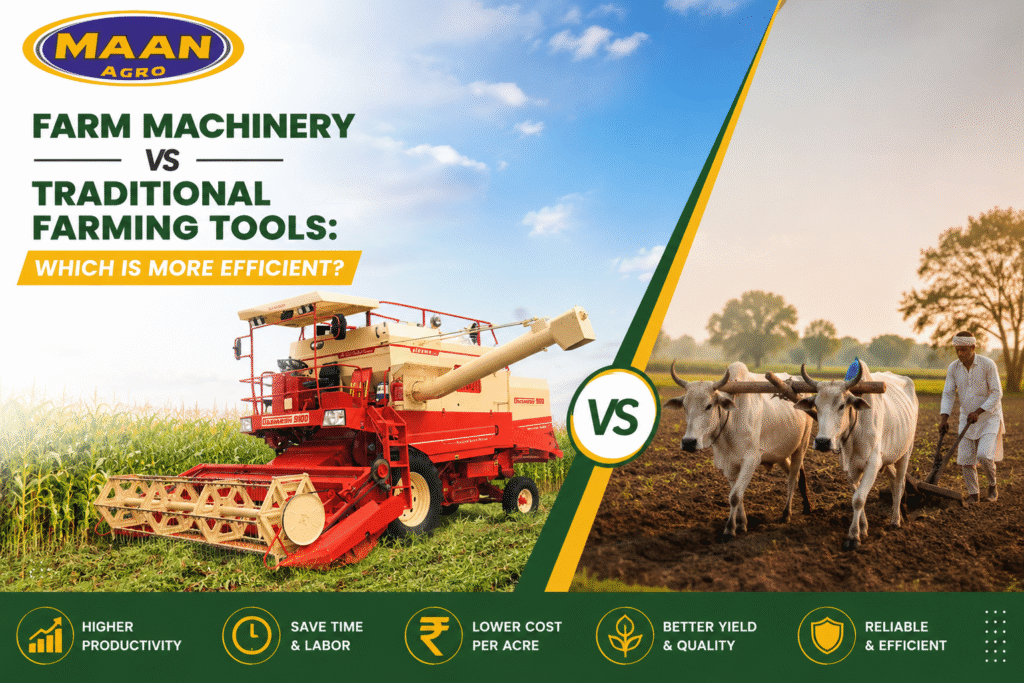
Overall, modern farm machinery is more efficient on larger farms, as they can cover more land in less time.
The advantages of large farms are:
- Quicker Field Operations
- Less reliance on labour
- More daily output
- Harvesting in time
- Operational delays were reduced
For commercial farming and large-scale agricultural operations, modern machinery can be of great advantage.
When Should Farmers Choose Traditional Tools?
The traditional tools are still relevant in agriculture.
They can assist with:
- Small pieces of land
- Kitchen gardens
- Limited areas
- Small-scale farming
- Manual-specific operations
- Places where machinery cannot easily work
Thus, traditional tools should not be regarded as completely obsolete. In certain farming conditions, they can be a good supplement to modern machinery.
When should farmers opt for modern farm machinery?
When farmers need to, they should use modern machines:
- Grow big plots
- Reduce dependence on labour
- Full harvest fast
- Increase field productivity
- Cut operational delays
- Efficient management of crop residues
- Boost the efficiency of farming
- Farming Operations Comparison
Comparison of Farming Operations
| Farming Operation | Traditional Method | Modern Machinery |
| Soil Preparation | Manual or animal-drawn tools | Rotavator and tractor |
| Sowing | Manual seed placement | Seed Drill/Super Seeder |
| Harvesting | Sickle and manual labour | Combine Harvester |
| Threshing | Separate manual operation | Combine Harvester |
| Crop Residue | Manual management | Super Seeder and other equipment |
| Labour Requirement | High | Lower |
| Speed | Slow | Fast |
Cost vs Long-Term Benefits
The cost of machinery is an important factor for farmers.
The traditional tools are cheaper to buy, but they need more labour and time.
Modern farm machinery is more expensive to buy, but it can pay off over the long run by:
- Reduced labour costs
- Speedier procedures
- Increased productivity
- Reduced harvesting lag
- Better utilisation of farming resources
Farmers have to weigh the cost of purchase against the potential savings over several seasons of farming.
Should Farmers Purchase or Lease Farm Machinery?
Farmers do not always have to buy expensive machinery.
Hiring or custom hiring can be a practical option when:
- Farm small.
- The machine is used once or twice a year only
- Purchase cost is high
- There are local machinery rental services.
For large farmers or agricultural service providers, regular machinery use may make the purchase more cost-effective.
Things to Consider Before Choosing
Before deciding between traditional tools or modern machinery, consider:
Size of Farm
The larger the farm, the greater the potential gains from mechanisation.
Type of Crop
Different machines and harvesting systems are needed for different crops.
Labour Supply
If labour is hard to find, machinery can reduce dependence.
Budget.
Consider both initial investment and ongoing operating costs.
Field Conditions
Smaller or irregular fields may require smaller equipment or hand tools.
Availability of Service
Select equipment with good service support and original spare parts.
Why Maan Agro for Agriculture Machinery?
“The right agricultural machinery is essential for the long-term efficiency of farming.
Maan Agro provides farmers with reliable agricultural machinery to increase their productivity and save time on important farming jobs.
Farmers can take advantage of:
- Good farm equipment
- Expert advice
- Replacement parts
- After-sales service you can count on
- Technical assistance
- Better machinery solutions.
If you are looking for a combine harvester, rotavator, super seeder, or other types of agricultural machinery, selecting the right equipment for your farm requirements can make a world of difference.
Also Read: How to Choose the Best Combine Harvester for Your Farm
Conclusion
Old-fashioned farm tools still have their uses for small farms and particular agricultural tasks. They’re cheap, they’re simple, and they’re easy to maintain.
However, modern farm machinery is generally more efficient for large-scale farming, as it saves time, reduces dependency on labour, improves productivity, and allows farmers to complete important operations within the right time.
Combine harvesters, rotavators and super seeders are machines that can help farmers to improve their harvesting, soil preparation, sowing and crop residue management.
The right choice is determined by the size of your farm, crop type, budget, labour availability, and farming requirements. Maan Agro is there for farmers looking for agricultural machine solutions to improve operational efficiency.
FAQs: Frequently Asked Questions
1. What makes the greater contribution to efficiency, modern farm machinery or old-fashioned farm tools?
Ans: Modern farm machinery is more efficient for medium and large farms, as it works faster, reduces labour requirements, and covers larger areas.
2. Are traditional farming implements still useful?
Ans. Yes. Traditional tools are useful in small farms, gardens, narrow fields, and farming operations where large machinery cannot operate easily.
3. Why is a combine harvester more efficient than harvesting by hand?
Ans. A combine harvester can do harvesting, threshing and cleaning at one go. This reduces the time and labour required.
4. What is a rotavator, and what does it do?
Ans: A rotavator is used to loosen and mix the soil, and it helps the farmers to make a proper seedbed before sowing.
5. How do Super Seeders help the farmers?
Ans: A super seeder helps farmers sow the next crop by managing crop residue. So there is no need for separate residue management operations.